

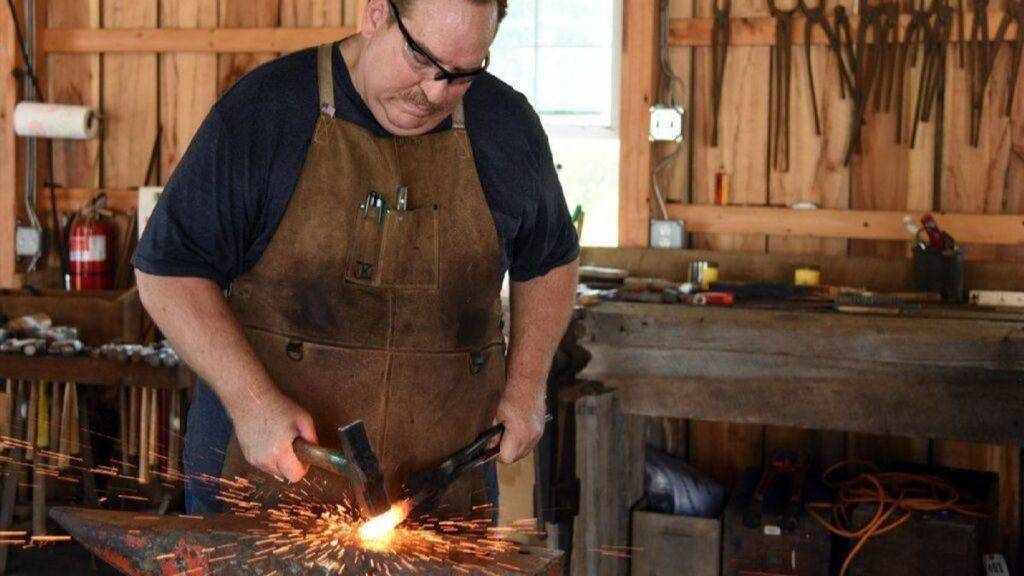
I am certain that there are plenty of different reasons to use an apron along with other considerations I have never even thought of when picking one. I did my own research but also asked our readers what their favourite leatherworking apron was and their answers were extremely valuable. I have gathered what they found to be the most useful qualities of a fantastic leatherworking apron below. In thinking about your perfect apron, you may want some of those features but not others. I love to explore the breadth and depth of a product design before choosing myself.
Shoulder Rather than Neck Straps
This was repeated often in the responses. Neck-straps on an apron appeared to sit uncomfortably on larger readers but also felt awkward for others who just don’t enjoy the sensation of something sitting on their neck.
Swinging Chest Pocket
This was a fantastic feature pointed out by Alan, a model maker for ILM and LucasFilm. You may see these pocket printer aprons; the bottom of the pocket isn’t stitched to the apron so that when you lean over, the pocket remains upright. This can be helpful if you’ve got a thickness gauge, ruler, or anything that will trickle out of your pocket.
Split Legs
This is where the base of the apron splits down the middle. Leatherworking is a combination of standing and sitting actions so this may be useful once you’re sitting with a clam or pony when hand-sewing.
Belly Cheat/Tradesman Apron
This is an old feature that’s seldom used today. Tradesman aprons had their shirts secure to a vest or jacket button. This was back when tradesmen used to wear suits to work. When the top button was unfastened, a tradesman’s apron converts to a waist apron.
Mesh Bottom Pockets
Some construction and woodworking aprons have bottom pockets with mesh openings. This is designed to permit sawdust to fall from the pocket instead of collect inside of it.
Water/Dirt Resistance
Most work aprons had Scotchgard, wax, or another kind of liquid-repelling treatment. This is important for many applications in leatherworking including border painting, dyeing, slicking, and wet-forming.
Heat Resistance
Most work aprons were made from cotton or leather (usually canvas or denim). Synthetic fibers are likely avoided because of poor heat resistance. There are a couple of leatherworking-related operations which may require minor heat resistance like creasing or heating adhesive. However, I was curious if there was anything out there, and I discovered several synthetic fabrics which were fire-resistant but weren’t used for ordinary clothing. They were fabrics which were typically used for something like point curtains or hazard suits. Many leatherworkers also do silversmithing, knifemaking, or metalworking and so having a heat-resistant apron is crucial in those situations.
Makers
A few readers made their own aprons and that I wanted to show a few examples :
Peter Reed
He makes his own shop aprons from leather. These are no-frills aprons that appear to work nicely for his clients.
Pat Woods
Pat makes Kevlar-reinforced work aprons for bike mechanics that are working with sheet metal. As Pat describes, wearing an apron when working with a sheet metal machine can help to deaden the vibrations generated when leaning against it. This apron also protects you against flying metal shards.
Candace S.
Candace has made her own apron and put in a number of nice details. I like these tiny embellishments on projects that individuals make for themselves because it reveals how much they like their job rather than it merely being a project to create.
I hope this post inspires you to have a look at your own apron and/or workwear for leatherworking. Are there other helpful characteristics of your apron that we did not cover and/or other things which you wear when leatherworking that you find helpful? I’d really like to hear more about it.